


Every change runs on your test set, whether a person or a coding agent wrote it. QA-Board puts its outputs and metrics next to the reference's (images, videos, point clouds, plots, flame graphs, test reports and logs) so everyone sees what changed, agrees it's better, and ships it. For camera and imaging pipelines, ML models, robotics, embedded code, performance, test suites and LLM agents: anything whose quality you measure.
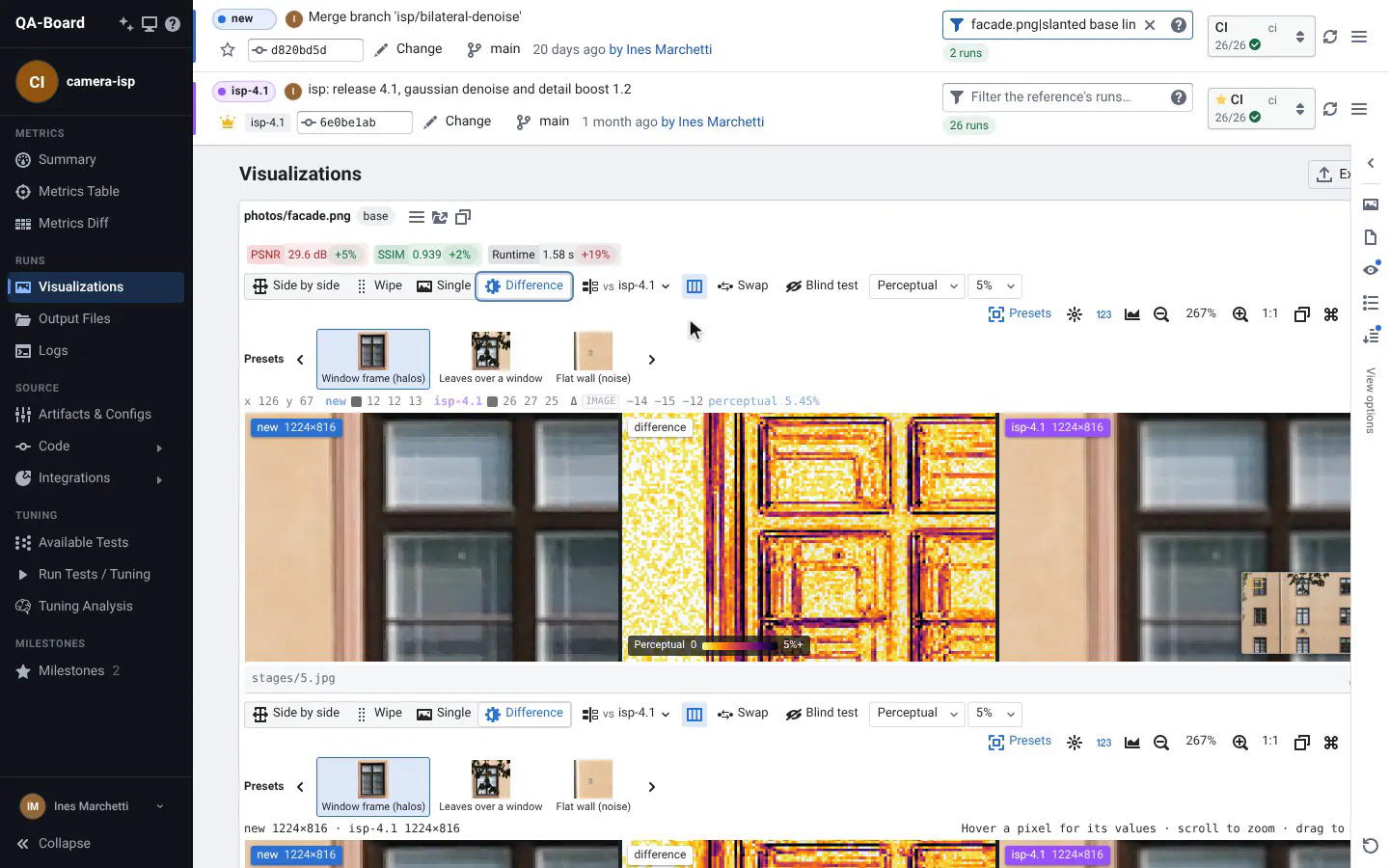
A new denoiser wins PSNR, and the images show the halos it adds. Clips and use cases on the website.
Start with a server on your computer. Add your project next, then your team.
- A server on your computer, in a few commands: one Compose file, or a kind cluster, starts QA-Board with demo projects to explore. Most of the time goes to downloading about 2 GB of images. See the quickstart.
- Your project, one step at a time:
qa init, then your inputs, your code, its metrics, its files. Most steps take 5 to 30 minutes, and each shows something new in the web app. Runners and CI come when you want them. See the steps and the tutorial. - A server for your team: the same Compose files, or the Helm chart, on your machines. Add single sign-on, project roles, backups and monitoring when you need them. See Start a server.
Or ask your coding agent. Coding agents such as Claude Code are good at this setup. Point yours at the quickstart to start a server, and give it the integration skill to add your project: see Coding agents.
What it needs: Docker or Kubernetes for the server. Runs save their files in a folder the server reads: a local folder on one computer, a shared one (NFS, SMB...) for a team. Where it isn't mounted, like on CI runners hosted by GitHub, runs send their files to the server over HTTP instead (experimental).
- Compare every commit with a reference: the reference branch, a release or a milestone, metric by metric, with regressions in red.
- Look at the outputs themselves: images down to the pixel with synced zoom and diffs, videos, point clouds and trajectories, plots, flame graphs, test reports, logs.
- Performance, from the files you have: flame graph diffs from what profilers write, and benchmark results from
pytest-benchmark, Google Benchmark, hyperfine, Criterion, JMH and
go test, each against the reference's. - Find the commit that changed it: History follows a metric across commits, input by input.
- Tune from the browser: parameter sweeps and automated tuning (
qa optimize, with Optuna). - People and agents together: coding agents read the same results as people (
qaboard.runs(url),qa runs, the HTTP API), andqa gate(experimental) fails CI when quality regresses, whoever wrote the change. - Fits your stack: wraps any executable, runs locally, on LSF, Dask, Celery or Kubernetes, or in CI (GitHub Actions, GitLab CI, Jenkins...). Open source (Apache 2.0) and self-hosted: your results stay on your network.
QA-Board has been Samsung's central quality platform since 2018: about 50 projects and more than 40 million runs. Running it is documented and tested in CI: zero-downtime upgrades and rollbacks, backups, and a Helm chart for Kubernetes. Users sign in with single sign-on or LDAP, project roles control access, and errors go to Sentry.
We're looking for teams who track quality, and we help them get started: setting up a self-hosted server, integrating the first projects, planning upgrades and storage as results grow. Write to arthur@fl.am, or open an issue.
To learn about the code's organization, or how to contribute, read CONTRIBUTING.md. Found a bug?
Submit an issue, and feel free to send pull requests to master.
QA-Board was started at Samsung by Arthur Flam.
Thanks to the following people for their contributions, testing, feedback or bug reports: Amir Fruchtman, Avi Schori, Yochay Doutsh, Itamar Persi, Amichay Amitay, Lena Grechikhin, Gal Hai, Rivka Emmanuel, Nadav Ofer. Thanks also to Sebastien Derhy, Elad Rozin, Nathan Levy, Shahaf Duenyas, Asaf Jazcilevich and Yoel Yaffe for supporting the project.
You don't see your name? Get in touch to be added to the list!